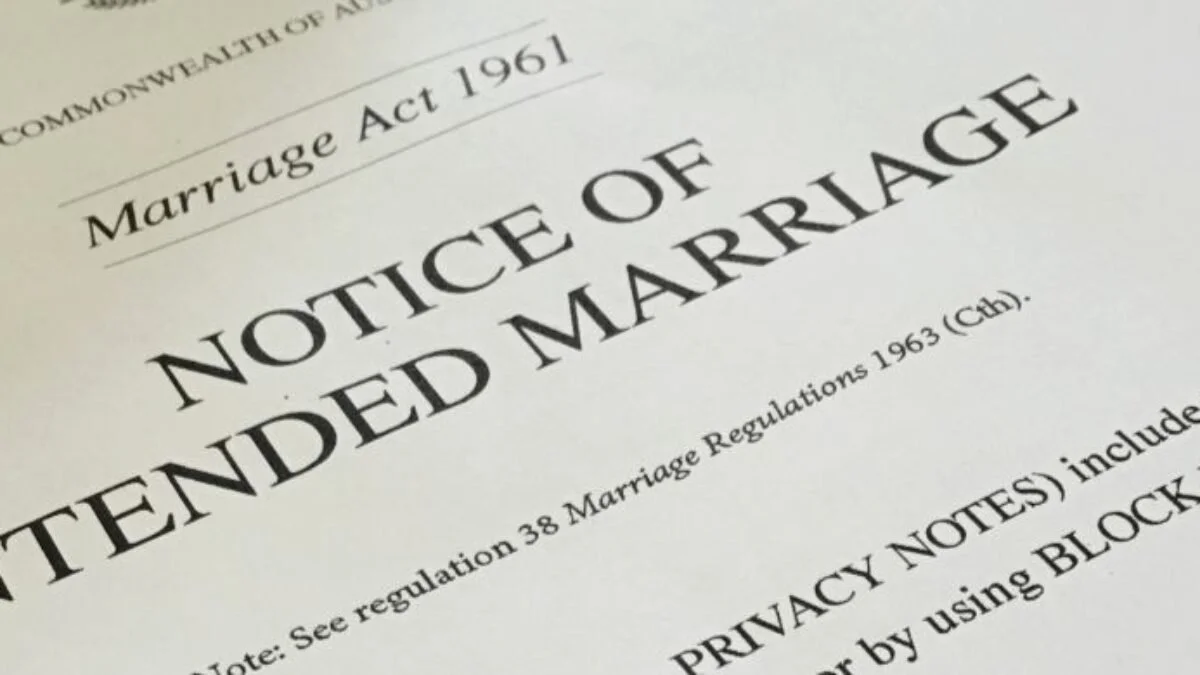
If you’re planning to marry in Australia, one of the first legal steps is completing a Notice of Intended Marriage—usually called a NOIM.
The name makes it sound rather formal, but the process itself is straightforward. The NOIM records your intention to marry and gives your authorised marriage celebrant the information required to begin preparing the legal paperwork.
Here’s what you need to know.
What is a Notice of Intended Marriage?
A Notice of Intended Marriage is the official form used to notify an authorised celebrant that you intend to marry.
Completing the NOIM does not mean you’re legally married, and it isn’t a marriage certificate. It simply begins the legal process and establishes that the required notice has been given.
Your celebrant will use the information on the form to prepare the remaining marriage documents and eventually register your marriage after the ceremony.
When does the NOIM need to be lodged?
Your celebrant must receive the completed NOIM:
At least one month before your wedding
No more than 18 months before your wedding
For example, if you’re marrying in November, you don’t need to wait until the weeks immediately before the ceremony. You can complete the form well in advance and know that an important part of the paperwork is already underway.
I recommend taking care of it early. It removes one more item from the wedding list and gives us time to resolve any document or identification questions without unnecessary pressure.
What information goes on the NOIM?
The form asks for information about each person intending to marry, including:
Your full legal name
Your date and place of birth
Your current address
Your occupation
Your current marital status
Details about your parents
Information about any previous marriage
It’s important that your names are recorded correctly and match the identification documents you intend to use.
The form must be witnessed by an authorised person. In most cases, the simplest option is to complete it with your marriage celebrant, who can make sure everything has been entered correctly.
What documents will your celebrant need?
Your celebrant must confirm your identity and your date and place of birth.
Depending on your circumstances, you may be asked to provide:
A passport or official birth certificate
Photo identification, such as a driver licence
Evidence that any previous marriage has ended, such as a divorce order
A former spouse’s death certificate, where applicable
Evidence of a legal name change, if your current name differs from your other documents
If any of your documents are not in English, let your celebrant know early. An English translation may be required.
You don’t necessarily need to have every document ready before first contacting a celebrant. Tell them what you have, and they can explain what else will be needed.
Can the NOIM be signed remotely?
Yes. A NOIM can be witnessed remotely using an audio-visual service, provided the witnessing requirements are properly followed.
This can be useful if you’re overseas, living interstate or simply unable to meet your celebrant immediately.
Remote witnessing doesn’t remove every in-person requirement. Before the marriage takes place, your celebrant must still meet separately and in person with each of you. Your celebrant will arrange this as part of the planning process.
What if we’re currently overseas?
You can complete a NOIM while overseas for a marriage that will take place in Australia.
However, the people authorised to witness the form overseas differ from those who can witness it within Australia. It’s worth speaking to your Australian celebrant before signing anything so that you can be directed to an appropriate witness.
This is much easier than discovering later that the form was witnessed incorrectly.
What if our wedding is less than one month away?
In limited circumstances, a prescribed authority may approve a shortening of the usual one-month notice period.
The accepted circumstances are restricted and can include particular travel or employment commitments, medical reasons, legal proceedings, errors in giving notice, or arrangements that would create significant difficulties if the wedding could not proceed.
A shortening of time is not automatic, and your celebrant cannot personally grant it. If this situation applies to you, contact a celebrant immediately. They can explain the process and help you identify the appropriate authority, but the final decision rests with that authority.
What happens if there’s a mistake on the form?
Don’t panic if you notice a spelling error or another genuine mistake after completing the NOIM.
Certain errors can be corrected in your celebrant’s presence before the marriage takes place. The important thing is to tell your celebrant as soon as you notice the problem rather than trying to alter the form yourself.
What happens after the NOIM is completed?
Once your celebrant has received the NOIM, they will guide you through the remaining legal steps.
These usually include:
Checking your identification and supporting documents
Confirming that you’re both legally able to marry
Meeting privately with each of you before the ceremony
Preparing the required declarations and marriage certificates
Making sure the ceremony contains the legally required wording
Registering the marriage after the wedding
The legal process matters, but it doesn’t need to dominate your experience. A good celebrant will manage the paperwork carefully and explain each step in plain language, leaving you free to concentrate on the ceremony itself.
Is the NOIM included in both ceremony options?
Yes. Preparation and management of the required marriage documents are included in both my fully personalised wedding ceremony and my legals-only ceremony.
The difference between those services is primarily the style and level of personalisation—not whether the legal work is handled properly.
If you’d like to understand that distinction more clearly, you can read my guide to how much a marriage celebrant costs in Sydney or explore my ceremony options.
Ready to begin?
If you have a wedding date in mind—or you simply want to understand what happens next—I can guide you through the NOIM and the rest of the legal process.
There’s no need to arrive knowing all the terminology or carrying a perfectly organised folder of documents. We can start with a conversation and work through it together.
For a broader overview of the legal process and the role I play, read what a marriage celebrant actually does.